Overview
Six products, no shared Design Vision, and a design team growing without the infrastructure to make that growth hold.
- The platform Brazil's leading medical education platform, covering a doctor's entire career from undergraduate preparation through residency, postgraduate specialisation, and career development.
- When I joined Six products designed in isolation by different squads. No shared principles, visual language, or interaction standards across the portfolio.
- What was broken Students hit different interaction models for the same core learning actions as they moved between products. Designers had no shared standards, no career path, and no structure to make effort compound.
- My role Lead the design function: align the portfolio under a shared vision, lead the strategic decision to consolidate products, deliver the unified classroom, build Design Ops, and scale the team.
- Products
- SanarFlix (incl. Residência Médica, merged) · Sanar Pós · Fellowship · Sanar DS · Design Ops
- Scope
- Design Vision, unified classroom, design system, Design Ops, career framework, experience redesign
- Methods
- Cross-product audit · Churn analysis · Career framework design · OKR workshops · 1:1 coaching · Mentorship programme
- Impact
- 86% satisfaction · Publishing hours → seconds · Practice adoption 7% → 50% · Team 6→12, 100% retention
The fragmentation problem
The products didn't share a design language. Neither did the teams designing them. And one product was serving a job that another already covered.
- Product layer Each product had evolved independently, with its own visual conventions, interaction patterns, and component decisions made locally. No shared principle to resolve conflicts across the portfolio.
- Portfolio overlap Sanar Residência Médica and SanarFlix were serving overlapping user needs with separate, duplicated infrastructure. Maintaining both products was splitting investment without meaningfully differentiating the experience for students.
- Content ops Taxonomy and tagging differed across products. Routine updates required engineering involvement, locking the content team inside sprint cycles and unable to operate autonomously.
- Classroom rebuilt six times The virtual classroom had been built from scratch in each product without a shared foundation. Students progressing between Sanar products hit different interaction models for the same core actions.
- Team infrastructure No career framework, no shared rituals, no criteria for what good design looked like at Sanar. Growth was informal and uneven. The team was working hard but without the infrastructure to make that effort compound.
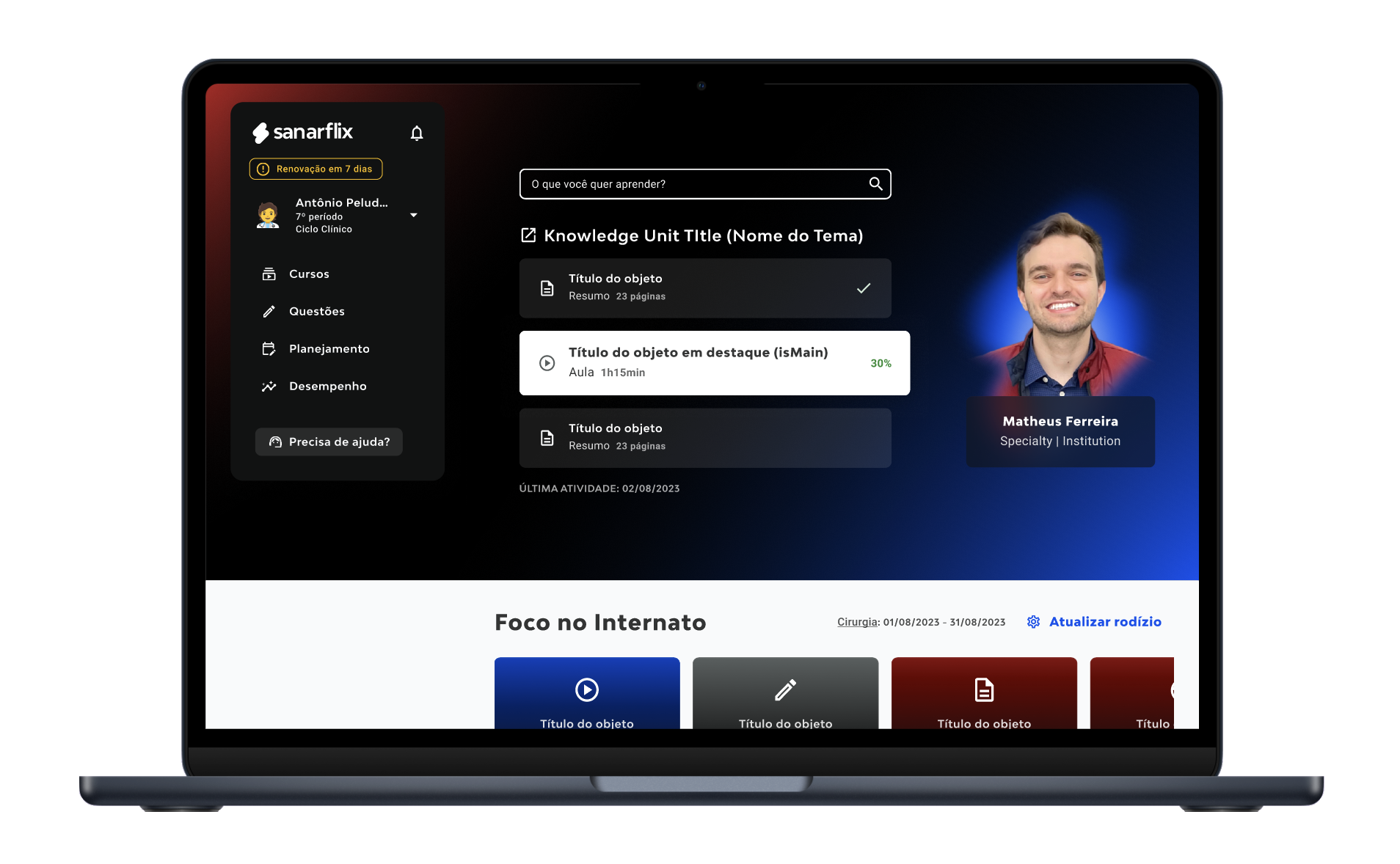
SanarFlix Visuals
Sanar, product ecosystem & design scope
Platform · 40k+ students
SanarFlix
Exam prep · Discontinued
Sanar Residência Médica
Post-graduation
Sanar Pós
Career development
Fellowship
Design System
Sanar DS
Infrastructure
Design Ops
Design Vision at scale
The Design Vision didn't stop at the product team. It covered every touchpoint a student encountered in their relationship with Sanar.
Beyond the product, I led the extension of the Design Vision across the full design cycle of the company, aligning marketing, audiovisual production (lesson recordings, on-screen graphics, and studio standards), and student materials (printed and digital) under the same visual language and principles. A student's relationship with Sanar didn't begin and end inside the app: they watched recorded classes, received physical and digital study materials, encountered marketing communications, and attended events. All of these touchpoints carried a visual voice, and none of them had been aligned until this point.
Bringing these departments into the same Design Vision meant running alignment workshops with marketing leads, setting visual standards for the audiovisual team's production pipeline, and creating material guidelines that content designers and educators could use independently. The result was a consistent Sanar experience that a student could recognise, and trust, across every format they encountered, not just within the app.
Work delivered
- Portfolio consolidation strategy A cross-departmental decision to discontinue Sanar Residência Médica and merge it into SanarFlix. Built the business case and aligned product, engineering, commercial, content, and customer success teams to execute the transition without user disruption.
- Cross-product audit Mapped interaction patterns, visual decisions, and component conventions across all six products. Framed the cost of fragmentation for leadership as a retention and scalability problem.
- Design Vision Aligned product, marketing, audiovisual production, and student materials under one shared design language and decision criteria. The first time all Sanar touchpoints pointed at the same standard.
- Unified classroom architecture A shared interaction model for content navigation, question mechanics, progress tracking, and session state. Each product extended it for its students' career stage rather than rebuilding from scratch.
- Sanar DS The first shared design language across all six products: tokens, components, patterns, and documentation. Built in 12 weeks, adopted by all squads within 3 months.
- CMS rebuild + taxonomy redesign Eliminated engineering dependency for content operations. Publishing time went from hours to seconds. Converted the content team from engineering-dependent to fully autonomous.
- SanarFlix redesign Practice flows, progress tracking, and home. Reframed Home as a personalisation surface. Practice adoption target set with product leadership: 7% → 50%. Also absorbed the Sanar Residência Médica product following the portfolio merger.
- Career framework Explicit hard and soft skill tracks at each level. Used for hiring profiles, mentorship pairing, and quarterly growth conversations. Made growth visible and achievable inside Sanar.
- Team scale Grew from 6 to 12 designers across two years of rapid growth. Zero unplanned departures.
Outcomes.
user satisfaction with SanarFlix updates, validating that a coherent, vision-led experience is what users feel as improvement, not just new features on top of fragmented foundations
content publishing time after the unified CMS, turning the content team from engineering-dependent to fully autonomous, and converting Sanar from an NPS detractor into a promoter
practice adoption target for SanarFlix, enabled by redesigned flows and progress feedback built on the shared design system and stable content infrastructure
designers grown with 100% retention across two years, a direct result of the career framework, mentorship programme, and Design Ops infrastructure that made growth visible and achievable inside Sanar
Learnings
What this taught me.
- → Discontinuing a product is a product strategy. Recognising when consolidation serves users better than maintaining parallel products and building the cross-departmental alignment to execute that decision without disruption is one of the harder, less visible parts of design leadership. The Sanar Residência Médica merger required more stakeholder work than any interface decision made that year.
- → A Design Vision has to come before a design system. The system is only as coherent as the principles underneath it. At Sanar, spending time on shared decision criteria before building components made adoption faster and conflicts rarer, because designers had a shared reference for what "right" looked like, not just a library of patterns to copy.
- → Design Ops is what keeps a design investment from leaking. Hiring 12 designers without a career framework, shared rituals, or cross-squad visibility would have produced 12 isolated contributors. The operational layer, career tracks, mentorship, quarterly development conversations, cross-team critique, was what made the team function as a function rather than a headcount.
- → Making growth explicit is a retention strategy. Designers left their previous companies because growth felt invisible or stalled. At Sanar, naming the skills, both hard and soft, at each career level, and reviewing them together regularly, gave people a reason to stay and a clear picture of what developing inside the company looked like. Zero unplanned departures across two years of rapid growth was not luck.