Overview
Three payment products. Fifteen markets. No shared design foundation across any of them.
- The platform EBANX connects global merchants to local payment methods across Latin America: 15 countries, hundreds of local payment options, and transaction volumes that make performance and clarity non-negotiable.
- The gap Three product lines EBANX One, Payouts, and Checkout each built independently. No shared standards, no unified experience, and a B2B dashboard that couldn't support how merchants actually operated across markets.
- The mandate Lead design across all three lines. Set direction, build the team, and ship products that gave merchants confidence to operate at scale and gave EBANX a defensible position in each market.
- Products
- EBANX One dashboard · Payout management · Checkout v3
- Methods
- Stakeholder interviews · Funnel analysis · Moderated usability testing · A/B testing
- Markets
- Brazil, Mexico, Colombia, Argentina, Chile, Peru 15 countries total
- Scale
- High-volume transaction processing · enterprise-grade uptime · low chargeback rates across LATAM
The problem
Merchants operating across LATAM had no unified view of their business. Every decision required exporting data or switching between disconnected systems.
- Dashboard No market-first hierarchy. Merchants managing multi-country operations couldn't surface the data that mattered by country, by payment method, by time period without exporting.
- Checkout Presenting all payment options at once, with no localisation by market. Low-friction local methods like Pix and OXXO weren't being surfaced costing approval rates.
- Foundations No shared component library. Design decisions were duplicated across squads, slowing velocity and producing an inconsistent experience across the three product lines.
- Direction Market-first information architecture for the dashboard, local payment methods as primary in checkout, and a unified component layer across EBANX One, Payouts, and Checkout.
Process
Two quarters. One evolving product.
We worked in structured quarterly cycles each following the full double diamond: discover, define, develop, deliver. Q1 validated the hybrid dashboard concept and SSO need. Q2 went deeper into user permissions, which Q1 research had flagged as the next critical gap.
Current state analysis
Mapped current-state flows across three product surfaces. Synthesised prior research to identify gaps and anchor the team on what was already known before running new work.
Stakeholder interviews
Stakeholder interviews across EBANX and global merchant accounts. SSO emerged as a must-have. User permissions surfaced as the next significant gap flagged as Q2 scope.
Hybrid dashboard concept
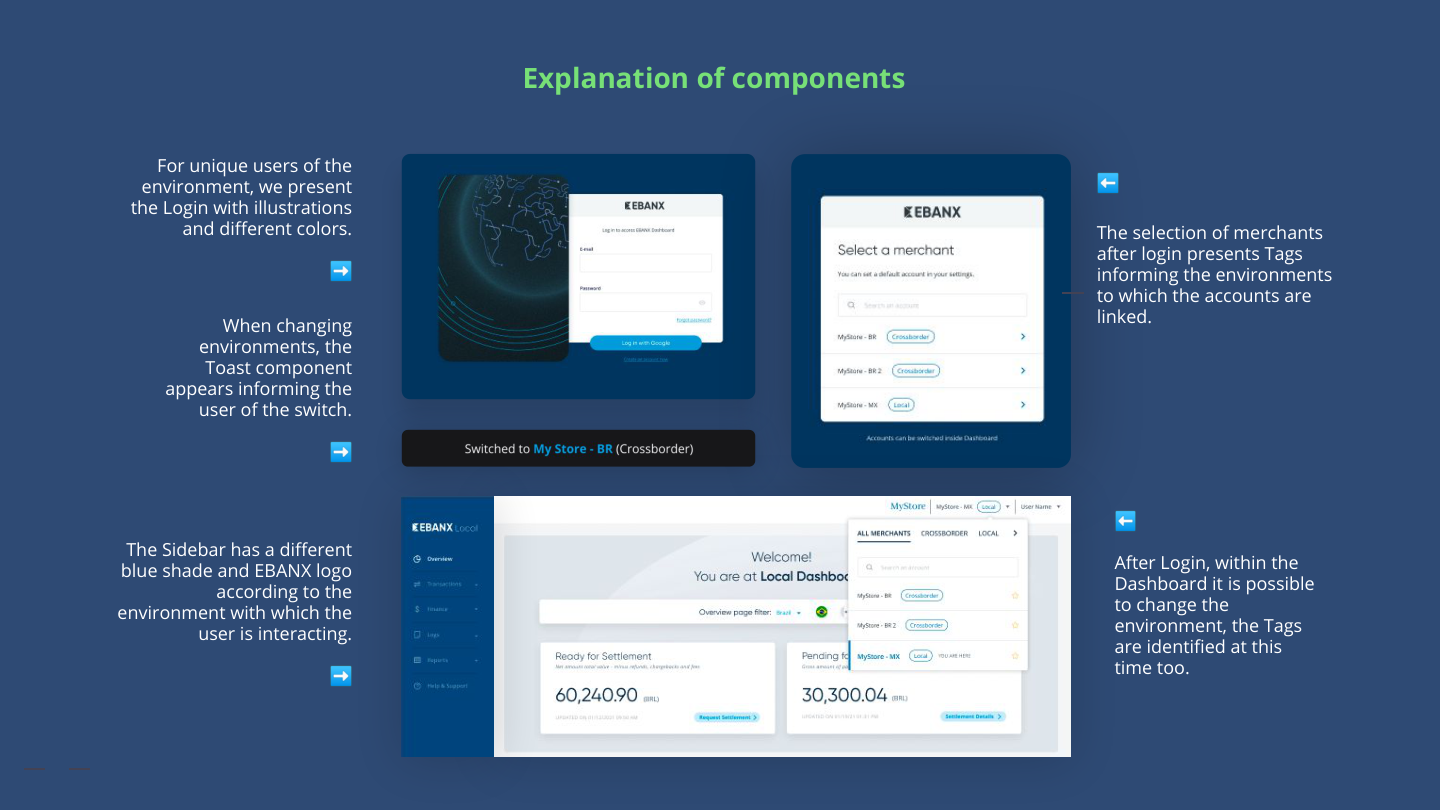
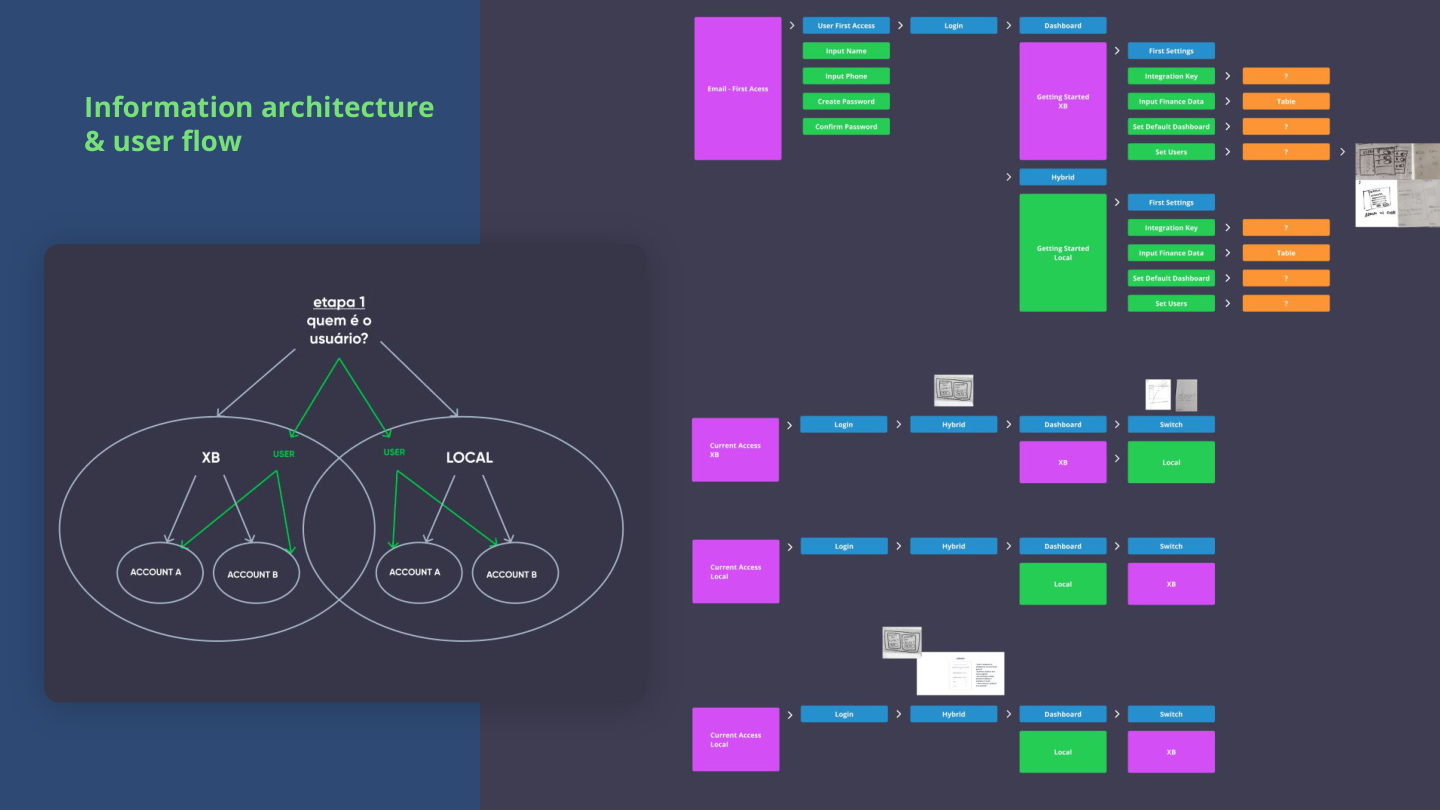
Co-creation workshops with design, product, and engineering. Benchmarked leading analytics and payments platforms. Defined the information architecture for the crossborder ↔ local switching flow.
Prototype & SUS validation
Prototyped and validated the SSO and hybrid dashboard flow with users. Strong usability results. Shipped to engineering with a prioritised backlog driving Q2 scope.
Permissions audit
Benchmarked permission models across global platforms. Analysed live account data from a major merchant to understand how teams were working around the existing access model in practice.
User interviews
Two rounds of interviews with Admin and Manager-role users at global merchant accounts focused on user management and access control workflows. Four clear pain points confirmed.
Permissions redesign
Proposed a 3-tier user hierarchy (Manager → Admin → Users), replaced fixed roles with flexible permission templates (default + custom), and designed country-level access controls.
Validate & iterate
Validated with merchants and internal stakeholders. Resolved all critical usability issues identified in Q1. Strong validation results. Q3 scope defined and handed off to engineering.
EBANX One, Merchant Dashboard
Research
Research grounded every decision.
of structured discovery before committing to scope Q1 validated the SSO and dashboard direction, Q2 tackled user permissions as the next critical gap
stakeholders interviewed across EBANX and global merchant accounts representing both the business and the end-operators who manage payments day to day
audited before redesign invitation flow, onboarding, and user permissions to ensure the work addressed root causes, not just visible symptoms
- No unified environment Merchants with crossborder and local operations had to log into two separate dashboards. Every day, teams alternated between systems to consolidate data. A basic operational need that had no designed solution.
- Access control used as a workaround Without country-level permissions, merchants created separate accounts to segregate users by region. Large global accounts had significant numbers of inactive, duplicate, or misconfigured users a compliance and operational risk.
- User management didn't scale The Settings interface had no hierarchy, no role transparency, and no way to manage access as teams grew or changed. High-turnover merchant teams couldn't maintain accurate permissions without manual oversight.
- Fixed roles against complex organisations Large merchants operate with specialised teams finance, customer service, chargeback operations each needing different access by country. Binary roles created friction, errors, and security gaps at scale.
Work delivered
- EBANX One dashboard Rebuilt around a market-first hierarchy. Merchants can now read volume, approval rates, and payment method performance by country in a single view without exporting or switching systems.
- SSO and unified environment Designed the crossborder ↔ local switching flow, eliminating the need for separate logins. Validated with users before engineering handoff; shipped as part of the Q1 release.
- User permissions Introduced a 3-tier access model (Manager → Admin → User) with country-level controls and permission templates. Resolved a structural gap that large merchants had been working around for years.
- Checkout v3 Progressive disclosure, local payment methods surfaced first, trust signals adapted per market. Approval rates reached 75–90% vs ~50% with standard international acquiring.
- Payout flows Redesigned confirmation steps and error states to reduce operational errors a recurring source of merchant support tickets.
- Shared component library First unified design system across EBANX One, Payouts, and Checkout. Reduced duplicated decisions across squads and raised the consistency bar across all surfaces.
- Team and practices Built and directed the design team. Established documentation standards and review practices that remained in use after I left making quality repeatable, not dependent on individuals.
Outcomes.
payment approval rates across LATAM, vs ~50% with standard international acquiring solutions, driven by localisation-first design and local payment method surfacing
Latin American markets unified in a single merchant experience through EBANX One, the first platform to consolidate multi-country operations, reconciliation, and payouts in one view
launch of EBANX One a single platform replacing fragmented, market-by-market tools, shipped on schedule after two structured design quarters, Q1 and Q2
Learnings
What this taught me.
- → B2B products carry high stakes for users merchants processing large transaction volumes need clarity and confidence just as much as any consumer product. Making that case to stakeholders early helped set a quality standard that held throughout the project.
- → Localisation in payments isn't just translation. Each LATAM market has different payment habits, trust signals, and terminology. Letting local context drive the IA rather than layering it on at the end was a product decision as much as a design one, and it required buy-in from the commercial team to move forward.
- → The component library and rituals the team built at EBANX were still being used after I left. Investing in how a team works the shared patterns, documentation, and review practices tends to have more lasting impact than individual deliverables.
- → Early engineering involvement closes expensive gaps. In Q1, a misalignment on how merchant IDs were structured nearly derailed the SSO concept. Bringing engineers into co-creation not just handoff caught it before it became a rework problem. By Q2 that was standard practice.
- → Quantified research changes the conversation at the roadmap level. When you can point to validated user data and clear quality benchmarks, scope discussions stop being about opinion and start being about evidence. It made it easier to argue for Q2 permissions work that hadn't been planned in the original brief.